
September Jobs Miss and Fed Repricing Reshape Rate Odds
Will the Federal Reserve Pause Rate Hikes in October 2026?
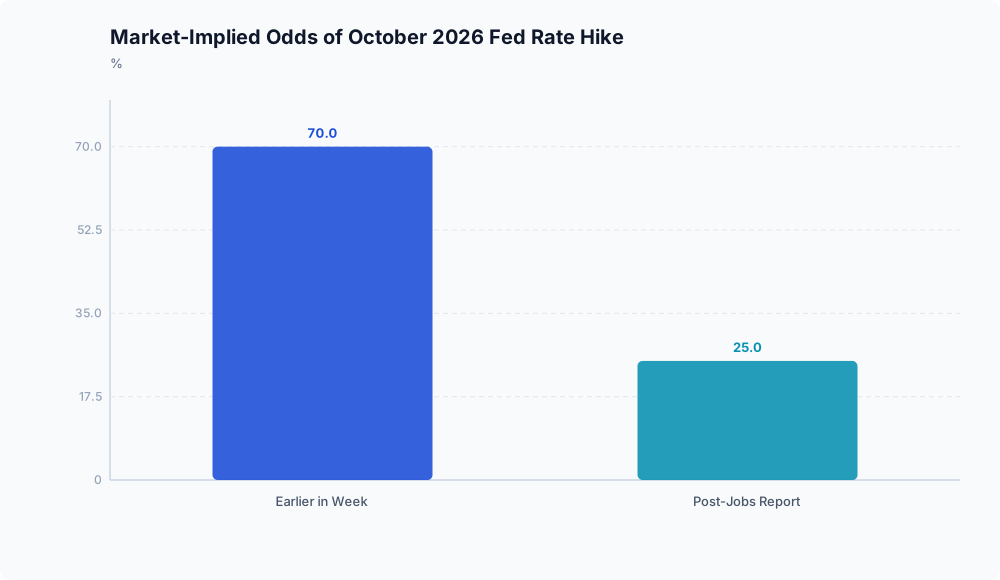
While not guaranteed, the Federal Reserve is now widely expected to hold interest rates steady in October 2026. Following a sharp slowdown in hiring and rising unemployment, market-implied odds of an October rate hike dropped from roughly 70% to approximately 25%, according to Invezz. This repricing reflects shifting investor positioning rather than a formal policy commitment from the central bank, leaving decisions for late 2026 uncertain.
A sharp labor market deceleration
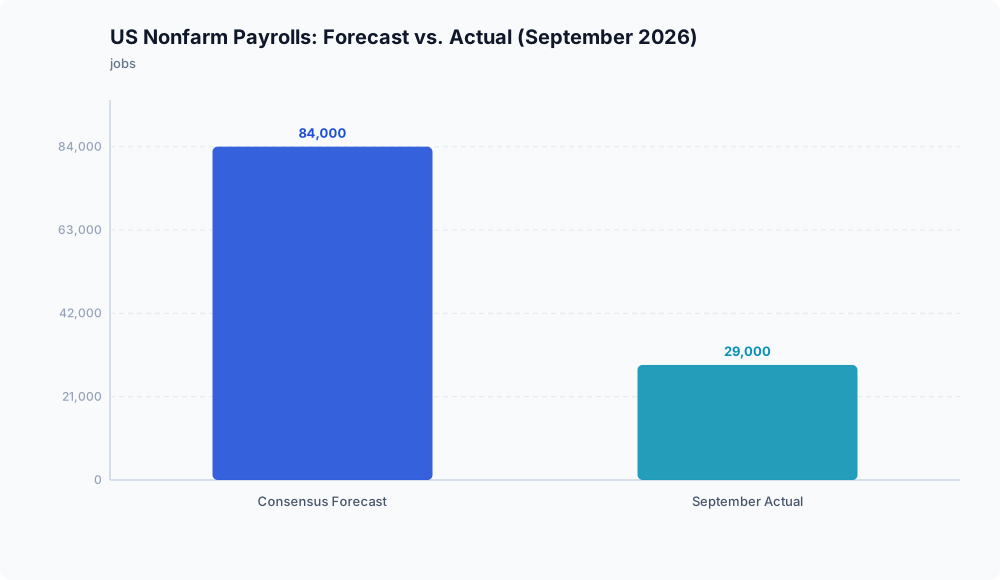
The U.S. labor market cooled significantly at the close of the third quarter, falling well short of economic forecasts. Nonfarm payrolls increased by just 29,000 in September 2026, trailing the consensus expectation of 84,000 by a wide margin, according to Invezz. Alongside this hiring shortfall, the national unemployment rate climbed to 4.2% from 4.1%, as reported by Invezz.
The deceleration was compounded by negative revisions to earlier data. Nonfarm payroll counts for July and August 2026 were revised down by a cumulative 60,000 jobs, with July lowered by 31,000 and August reduced by 29,000, as reported by Invezz. These retroactive markdowns show that employment momentum had already begun softening earlier in the summer.
Specific industries also point to persistent balance-sheet pressures under prolonged high borrowing costs. The U.S. financial activities sector shed 129,000 positions between its peak in May 2025 and September 2026, according to Invezz. This ongoing contraction points to deal-cycle fatigue and tighter credit conditions within transaction-heavy sectors.
Interest rate markets rapidly reprice policy
The combination of sluggish job growth, rising unemployment, and downward revisions prompted an immediate recalibration in interest rate futures. Market-implied expectations for a Federal Reserve rate increase in October 2026 fell to approximately 25%, down sharply from about 70% earlier that week, as documented by Invezz.
| Metric | Previous Trend / Forecast | September 2026 Actual | Source |
|---|---|---|---|
| Nonfarm Payroll Growth | 84,000 (Consensus) | 29,000 | Invezz |
| Unemployment Rate | 4.1% | 4.2% | Invezz |
| July & August Net Revisions | Baseline estimates | -60,000 (-31k July / -29k Aug) | Invezz |
| October Rate Hike Implied Probability | ~70% (Earlier in week) | ~25% | Invezz |
Despite the swift drop in October expectations, the policy outlook for the remainder of the year remains unresolved. Investors face ongoing uncertainty over whether the Federal Reserve will resume rate hikes at its December 2026 meeting or keep policy rates unchanged through year-end.
Valuation relief vs. corporate earnings risks
In the immediate term, pricing out near-term rate hikes provides valuation relief for equities. When terminal rate assumptions fall, discount-rate pressures ease, supporting equity multiples, particularly across interest-rate-sensitive assets.
This valuation benefit introduces a trade-off. Slower policy tightening reduces the immediate cost of capital and stabilizes valuation multiples. However, if the labor slowdown spreads from finance into broader consumer-facing sectors, weakening aggregate demand could erode corporate revenues.
A central bank pause driven by economic cooling offers only temporary multiple expansion if falling consumer demand ultimately leads to downward revisions in corporate earnings forecasts.
Analytical takeaway

The September 2026 employment figures shift the primary market risk away from aggressive Federal Reserve tightening toward underlying macroeconomic resilience. While the immediate threat of higher interest rates has faded for the October meeting, investors must now assess whether the labor deceleration stabilizes or deepens into broader demand destruction that multiple expansion cannot offset.
Disclaimer: This analysis is for informational purposes only and does not constitute investment, financial, real estate, or legal advice. Always consult a licensed financial advisor before making investment decisions.
Frequently asked questions
Does a single month of weak payroll growth guarantee the Federal Reserve will hold interest rates steady in October?
No. While market-implied probabilities for an October hike dropped to around 25%, according to Invezz, these figures reflect shifting market positioning rather than a definitive central bank commitment. The Federal Reserve has not ruled out future policy action, leaving both the October and December 2026 meetings subject to evolving economic conditions.
How does labor deceleration shift the market focus from interest rate risk to earnings risk?
When labor market momentum slows, investors initially benefit from lower projected interest rates, which eases discount-rate pressure on asset valuations. However, if employment contractions persist, such as the 129,000 jobs shed in financial activities reported by Invezz, weaker consumer and business spending threatens corporate revenue growth, shifting the primary threat to stock prices from rising rates to falling earnings.