
10-Year Treasury Yield and Commercial Real Estate Refinancing
10-Year Treasury Yield and Commercial Real Estate Refinancing
What does the recent consolidation of the 10-year U.S. Treasury yield mean for commercial real estate refinancing?
Even though cooling labor data recently stopped long-term yields from climbing higher, base borrowing benchmarks remain locked at multi-year highs. For commercial real estate borrowers facing debt maturities, this means all-in refinancing costs remain substantially higher than the rates on legacy loans. Unless property net operating income has grown fast enough to offset these borrowing costs, refinancing into today’s yield environment risks creating “negative leverage”—where debt costs exceed property yields—forcing owners to commit additional equity or restructure their debt.
The Macroeconomic Stalemate: Why Yields Found a Floor
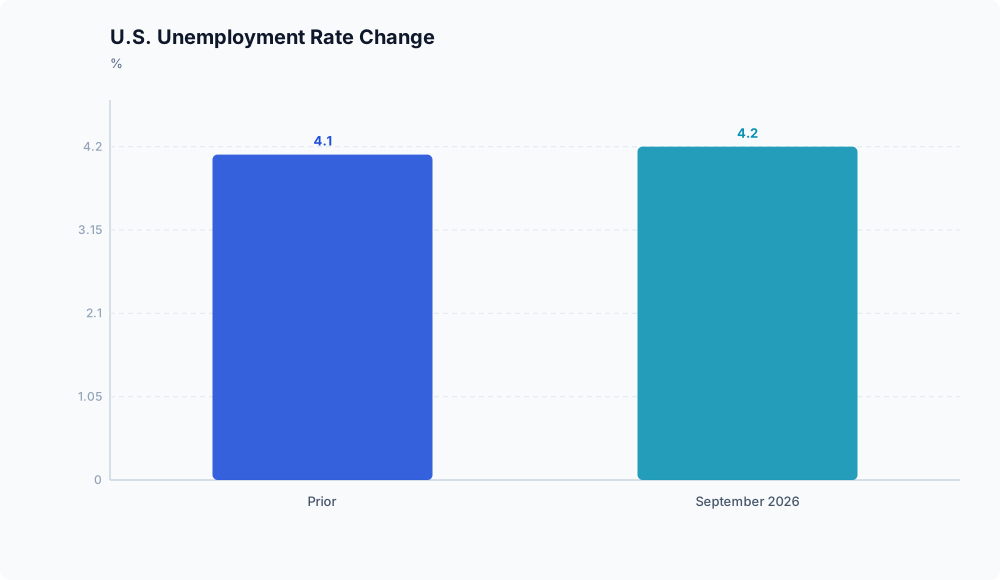
The retreat of the 10-year U.S. Treasury yield from its recent peak of 5.34% into the 5.20%–5.24% range was catalyzed by evidence of cooling domestic labor conditions. According to Bureau of Labor Statistics data for September 2026, the U.S. unemployment rate edged up to 4.2% from 4.1% (QUE.com).
This labor signal prompted an immediate reassessment of Federal Reserve policy expectations. Prior to the employment release, traders had placed a 64% probability on an interest rate hike at the October 27–28 Federal Open Market Committee (FOMC) meeting. Following the release on October 2, that probability fell to below 21% on CME Group’s FedWatch tool (QUE.com).
While diminished hike expectations halted the yield surge, downward movement was quickly limited by persistent cost pressures:
- Energy Inflation: Brent crude settled at $102.31 per barrel on October 1, 2026, keeping inflation risks elevated and discouraging investors from betting on aggressive central bank rate cuts (QUE.com).
- Global Sovereign Spreads: On October 1, 2026, the yield on France’s 10-year government bond climbed to 4.924%, and the spread between French and German 10-year bonds widened to 1.4 percentage points, highlighting broader debt market fragmentation (QUE.com).
Together, these crosscurrents stabilized 10-year Treasuries within the 5.20%–5.24% range: softening labor data capped the upside, but energy costs and international bond volatility established a firm floor.
Refinancing Mechanics and the Risk of Negative Leverage
Commercial real estate financing depends directly on benchmark risk-free rates. Lenders establish debt pricing by adding a credit risk spread onto reference yields such as the 10-year U.S. Treasury note. When benchmark yields rise, baseline debt service requirements across fixed-rate property loans increase in tandem.
This rate reset represents a sharp transition from earlier baseline conditions. According to Nevada Real Estate Group, the 10-year U.S. Treasury yield rose from 3.97% on February 27, 2026, to approximately 4.91% on September 10, 2026. Residential borrowing tracked this upward move, with Freddie Mac’s 30-year fixed mortgage rate increasing from 5.98% in late February to 6.71% in the week of September 3, 2026 (Nevada Real Estate Group).
┌────────────────────────────────────────────────────────┐
│              Refinancing Spread Mechanics              │
├────────────────────────────────────────────────────────┤
│  Benchmark Rate (e.g., 10-Yr Treasury: 5.20%–5.24%)    │
│  + Credit Risk Spread                                  │
│  ────────────────────────────────────────────────────  │
│  = All-In Debt Cost                                    │
│                                                        │
│  If All-In Debt Cost > Property Capitalization Rate:   │
│  ↳ Negative Spread / Negative Financial Leverage       │
│  ↳ Cash-on-Cash Yields Compress                        │
│  ↳ Potential Need for Gap Equity Injections             │
└────────────────────────────────────────────────────────┘
When all-in borrowing costs exceed a property’s capitalization rate (net operating income divided by asset value), the borrower enters negative financial leverage. Because benchmark yields are hovering well above 5%, total debt costs push upward. If property valuations have not fully adjusted or cap rates remain compressed from prior market cycles, refinancing at current debt terms reduces net property cash flow and can cause shortfalls in required debt-service coverage ratios (DSCR).
Evidential Boundaries Across Capital Markets

Evaluating the exact magnitude of these refinancing pressures requires distinguishing between verified macroeconomic indicators and gaps in transaction data:
- Commercial Real Estate Metrics: While the surge in Treasury yields and residential borrowing benchmarks is documented, specific empirical figures for prevailing institutional commercial loan spreads, average capitalization rates, transaction volumes, and default rates are not recorded in the available evidence. Consequently, the exact spread deficit across specific commercial asset classes remains an analytical projection rather than an empirically measured figure.
- Residential Comparisons: Elevated Treasury yields historically sustain high consumer mortgage rates, which can incentivize homeowners with low legacy borrowing rates to hold off on selling. However, because specific figures on current housing inventory turnover or homeowner mobility are not documented in the verified record, the exact severity of this lock-in effect cannot be verified directly.
- Cross-Border Spillovers: Widening sovereign spreads in Europe indicate broader lender caution in sovereign debt markets (QUE.com), but translating these sovereign dynamics directly into commercial mortgage defaults or institutional distress remains a conditional interpretation.
Strategic Takeaways for Borrowers

The pullback of the 10-year Treasury yield from 5.34% to the 5.20%–5.24% range offers psychological stability, confirming that immediate rate hikes have been priced out. However, it does not provide genuine cost relief.
Because three-digit oil prices sustain inflation risks, the market has established a high baseline for long-term debt. Borrowers facing maturing commercial loans must navigate a market where the risk-free rate alone is higher than the all-in debt cost of many pre-2026 originations. Until benchmark yields fall significantly or property cap rates adjust upward to restore positive spreads, refinancing will continue to require defensive capital structures, including additional sponsor equity and renegotiated debt terms.
Disclaimer: This analysis is for informational purposes only and does not constitute investment, financial, real estate, or legal advice. Always consult a licensed financial advisor before making investment decisions.