
How Rising Bond Yields Compress the Equity Risk Premium
How higher sovereign yields are squeezing the equity risk premium
Rising risk-free benchmark yields compress the equity risk premium (ERP) by lifting the baseline hurdle rate equities must clear. With Treasury yields pushing above 5% (REX Shares) and the Federal Reserve projecting restrictive policy with a median rate of 4.1% through year-end 2026 (Crestwood Advisors), the excess return investors receive for taking on equity volatility narrows. That shift increases the opportunity cost of capital and raises the discount rate applied to corporate earnings, making government debt a direct alternative to growth stocks and dividend-paying equities.
Restrictive monetary policy and elevated yields
The upward shift in sovereign yields stems from persistent price pressures and central bank tightening. On September 16, 2026, the Federal Reserve voted 12 to 0 to raise the target range for the federal funds rate to 3.75% to 4%, according to Crestwood Advisors. This unanimous decision followed August inflation data showing headline Consumer Price Index (CPI) increases of 0.4% month-over-month and 3.4% year-over-year (Crestwood Advisors).
Fixed-income markets are repricing for an extended rate plateau alongside the immediate increase. Crestwood Advisors reported that the Fed’s median Summary of Economic Projections pointed to a year-end 2026 federal funds rate of 4.1%, guidance that removed expectations for near-term monetary easing.
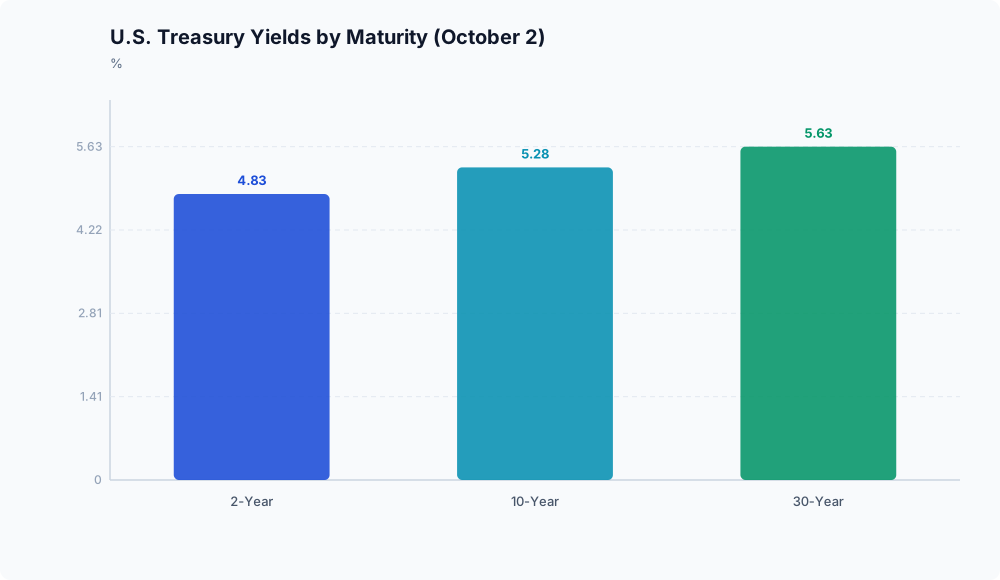
Input costs in the broader economy have also remained high, with retail diesel reaching $6.38 per gallon on September 28 (REX Shares). Treasury yields across the curve climbed to long-term highs. As of the October 2 close, the 2-year Treasury yielded 4.83%, the 10-year stood at 5.28%, and the 30-year reached 5.63%, according to REX Shares.
Discount rates and equity risk premia
The equity risk premium represents the compensation investors require for holding volatile stocks instead of risk-free government bonds. Conceptually, it is measured as the gap between equity earnings yields and sovereign benchmark rates.
When risk-free rates rise, that spread shrinks unless equity valuations fall or corporate earnings increase enough to restore the buffer. In discounted cash-flow models, higher long-term yields raise the discount rate applied to future corporate cash flows. This pressures high-multiple growth equities, whose projected cash flows are concentrated in distant years.
Higher yields also challenge equity bond proxies, such as utilities and real estate investment trusts (REITs). With 10-year and 30-year Treasuries yielding 5.28% and 5.63% respectively (REX Shares), investors can secure income streams without taking on equity price risk.
This compression is evident in benchmark equity valuations. As of September 2026, the S&P 500 earnings yield stood at 3.838%, according to GuruFocus. Compared to the 10-year Treasury yield of 5.28% (REX Shares), the earnings yield spread over sovereign debt fell into negative territory. While economic theory indicates capital shifts toward Treasuries under these conditions, published flow-of-funds or redemption figures for REITs and utilities are not present in current reporting, leaving sector-level reallocation volumes as an analytical inference.
Credit stress and allocation headwinds

The compression in equity risk premiums coincides with signs of widening credit stress and slower macroeconomic momentum. Credit markets show evidence of elevated borrower distress:
- The ICE BofA US High Yield option-adjusted spread widened from 293 basis points on September 25 to 324 basis points on October 1 (REX Shares).
- The Fitch US private credit default rate reached a record 6.3% for the 12 months ending August 2026, rising from 6.1% in July (REX Shares).
- Labor momentum slowed during the same period, with September nonfarm payroll growth registering at +29,000 alongside an unemployment rate of 4.2% (REX Shares).
Portfolio allocation effects

For portfolio allocators, risk-free yields above 5% and widening credit spreads alter portfolio construction. When risk-free sovereign debt offers competitive real yields, equities must deliver stronger earnings growth to justify their valuation multiples and risk profile. Without acceleration in corporate profitability, higher risk-free hurdle rates keep both growth equity multiples and yield-oriented stocks under valuation pressure.
Disclaimer: This analysis is for informational purposes only and does not constitute investment, financial, real estate, or legal advice. Always consult a licensed financial advisor before making investment decisions.