
Yield Curve Bear Steepening Real Estate Impact and Risks
Yield curve bear steepening and its real estate impact
How does a spike in benchmark Treasury yields affect property financing and upcoming loan maturities?
When benchmark long-term yields surge, borrowing hurdles across both commercial and residential real estate rise in tandem. In commercial property markets, higher yields widen the debt gap between maturing loans and allowable refinancing proceeds, compounding stress for asset classes already facing elevated distress. In residential markets, higher benchmark yields elevate baseline mortgage borrowing costs, restricting affordability for prospective buyers and reinforcing inventory lock-in for existing homeowners.
Benchmark yields reach multi-decade highs
On October 6, 2026, the benchmark U.S. 10-year Treasury note yield rose by 0.072 percentage points to reach 5.343%, its highest level since 2002, according to market data reported by CNBC.
The primary catalyst for this move was supply-side positioning. Traders adjusted ahead of a scheduled government bond auction, pushing bond prices down and yields upward, as documented by CNBC.
Analytically, long-dated yields rising rapidly around debt issuance reflects a bear-steepening dynamic. In this environment, investors demand a higher yield concession and term premium to absorb substantial new Treasury supply. While broader commentary often associates yield curve steepening with inflation expectations, the confirmed record attributes this specific rate spike to auction positioning, leaving the direct role of long-term inflation metrics unverified within the reported data.
Commercial real estate: the multifamily refinancing wall
Elevated benchmark borrowing costs have intensified strain on commercial real estate (CRE) capital structures. Across the broader commercial market, nearly $1.0 trillion in CRE debt matured in 2025, and well over $1.5 trillion is projected to mature by the end of 2026, with top estimates reaching $1.8 trillion, according to MMG Real Estate Advisors.
In the United States, total distressed CRE debt volume reached $126.6 billion in the third quarter of 2025, an 18% increase year over year, with the multifamily sector accounting for $22.8 billion, or 18% of that total, according to MMG Real Estate Advisors.
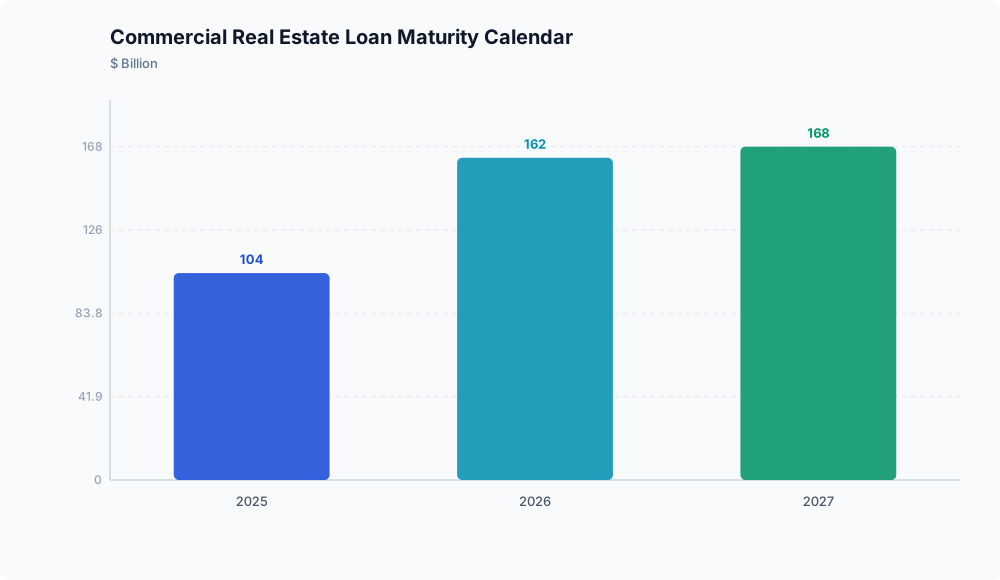
Within the multifamily sector specifically, this distress intersects with an accelerating maturity schedule documented by MMG Real Estate Advisors:
- 2025: Approximately $104.1 billion in U.S. multifamily loans mature.
- 2026: Multifamily loan maturities surge 56% to roughly $162.1 billion.
- 2027: Maturities edge higher to $167.7 billion.
These projections, published by MMG Real Estate Advisors, point to compounding refinancing shortfalls. When legacy debt originated during lower-rate regimes reaches maturity, lower debt service coverage ratios (DSCRs) and higher debt yield requirements force property owners to contribute fresh gap equity, negotiate recapitalizations, or enter formal loan workouts.
Certain analytical limits remain. The reported dataset tracks distress volumes and maturity schedules through late 2025, but does not provide figures on realized loss severities, lender concession rates, or the prevalence of contractual extension options. Consequently, the eventual balance among loan modifications, foreclosures, and distressed asset sales across 2026 and 2027 cannot be definitively projected from the current record.
Residential transmission and liquidity friction

The benchmark 10-year Treasury yield also underpins long-term fixed-rate mortgage pricing, as residential lenders set consumer interest rates at a spread above the risk-free rate.
While market mechanisms dictate that rising benchmark yields translate into higher primary mortgage rates, direct figures on prevailing consumer mortgage rates, lender spreads, and aggregate residential transaction volumes are not included in the dataset reported by CNBC.
From an analytical standpoint, benchmark yields holding at multi-decade highs suggest two structural frictions in the housing market:
- Affordability constraints: Increased financing costs reduce buyer purchasing power and inflate debt service obligations for new originations.
- The lock-in effect: Existing homeowners with low-rate mortgages face a strong disincentive to sell or refinance at prevailing rates, restricting secondary market inventory.
While these transmission channels are theoretically expected, the precise degree of residential transaction slowdown remains an inference until primary lending and sales volume metrics are measured alongside the benchmark yield data from CNBC.
Analytical takeaway

The surge in the 10-year Treasury yield to 5.343% shows that elevated capital costs directly challenge debt-reliant property sectors, as documented by CNBC. For commercial owners, especially in multifamily, the steep jump in 2026 maturities means refinancing at higher yields will require additional sponsor equity or formal lender renegotiations. For housing, multi-decade benchmark highs keep borrowing hurdles elevated, dampening both transaction activity and inventory turnover.
Disclaimer: This analysis is for informational purposes only and does not constitute investment, financial, real estate, or legal advice. Always consult a licensed financial advisor before making investment decisions.
FAQ
What is the difference between a bear steepener and a bull steepener for property developers?
- Bear steepener: Occurs when long-term interest rates rise faster than short-term rates, typically driven by debt supply pressures or rising term premiums. For developers, this directly increases long-term debt costs, takeout financing hurdles, and required property yields.
- Bull steepener: Occurs when short-term interest rates fall faster than long-term rates, typically due to central bank policy cuts during an economic slowdown. For developers, this can provide relief on floating-rate construction loans and short-term debt, even if long-term takeout yields remain steady.