Where Business Fixed Investment in Technology Is Flowing
Where Is Business Fixed Investment in Technology Actually Flowing?
Is corporate spending on technology hardware accelerating across the board, or is it concentrated in specific sectors?
The empirical evidence reveals that business fixed investment in technology is not expanding uniformly. Instead, it is experiencing an intense bifurcation: capital outlays are surging aggressively into advanced semiconductor fabrication and high-performance memory infrastructure driven by artificial intelligence demand, while traditional integrated device manufacturers (IDMs) are significantly reducing capital intensity.
While comprehensive macroeconomic series tracking aggregate enterprise equipment and intellectual property (IP) across all sectors are not detailed in the available data, semiconductor capital deployment provides a clear benchmark for specialized technology spending.
Headline Growth: A Sharp Acceleration Forecast for 2026
Rather than moderating under broad macroeconomic headwinds, top-line semiconductor manufacturing investment has maintained sustained upward momentum.
According to data compiled by Bill Jewell of Semiconductor Intelligence, total global semiconductor industry capital expenditure (CapEx) grew 7% year-over-year in 2025 to reach $166 billion.
Looking forward, Bill Jewell of Semiconductor Intelligence projects that industry CapEx will accelerate sharply in 2026, climbing 20% to reach $200 billion. This trajectory indicates that enterprises directing capital toward leading computing capacity are prioritizing long-term strategic technology shifts over broader macroeconomic uncertainty.
Capital Concentration: Advanced Foundries and Memory
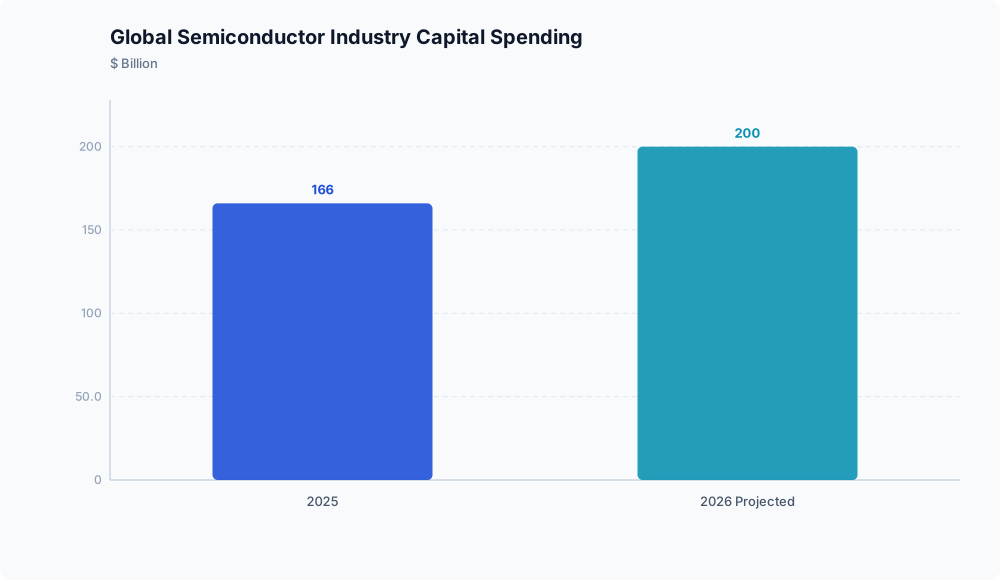
The anticipated expansion to $200 billion is heavily concentrated among pure-play advanced foundries and memory chipmakers:
- Leading-Edge Foundry Allocation: TSMC led the industry in 2025 with $40.9 billion in CapEx, representing 25% of all global semiconductor spending, according to Bill Jewell of Semiconductor Intelligence. TSMC projects its 2026 CapEx will increase to between $52 billion and $56 billion, reflecting annual growth of 27% to 37% Bill Jewell of Semiconductor Intelligence.
- Memory Capacity Expansion: Memory producers are forecast by Bill Jewell of Semiconductor Intelligence to account for the largest single share of semiconductor CapEx in 2026 at 45%. This surge is anchored by Samsung’s announcement that it will invest more than 110 trillion won ($74 billion) in 2026 to “secure leadership in the AI semiconductor era” Bill Jewell of Semiconductor Intelligence.
Market commentary from Investing.com indicates that this multi-year spending momentum into 2026 has helped support premium valuations for upstream semiconductor equipment providers tied to these leading-edge roadmaps.
The IDM Retreat: Legacy Pullbacks
In sharp contrast to pure-play foundries and memory producers, traditional integrated device manufacturers (IDMs) have curtailed their fixed capital deployment.
As reported by Bill Jewell of Semiconductor Intelligence, total IDM CapEx declined 25% in 2025 to $41.3 billion:
- Intel: Reduced its 2025 capital expenditures by 29% to $17.7 billion Bill Jewell of Semiconductor Intelligence.
- Texas Instruments: Guided its 2026 CapEx downward to between $2 billion and $3 billion, a substantial drop from $4.6 billion in 2025 Bill Jewell of Semiconductor Intelligence.
Analytical Synthesis: What the Evidence Means
The data establishes that the headline 20% industry spending growth projected for 2026 does not signal a broad-based, sector-wide hardware boom. Corporate capital allocation is dividing into two distinct paths:
- Strategic AI Infrastructure: Mission-critical manufacturing lines continue to receive expanding capital commitments because strategic positioning outweighs broader market cycles.
- Cyclical Re-alignment: Legacy facilities and traditional IDM footprints are actively paring back investments to align with market conditions.
Analytical Boundaries: It is critical to recognize the limits of the reported figures. The documented data specifically measures semiconductor manufacturing assets. It does not track broader diversified industrial automation, physical enterprise hardware, or universal corporate software IP. Inferring an economy-wide surge in fixed investment outside of advanced semiconductor supply chains remains analytically unverified until broader equipment expenditure series confirm similar trends.
Disclaimer: This analysis is for informational purposes only and does not constitute investment, financial, real estate, or legal advice. Always consult a licensed financial advisor before making investment decisions.