
Fed Reserve Management Liquidity and Equity Discount Rate
Plumbing vs. policy: why the Fed’s balance sheet expansion is not an equity stimulus
Does the Federal Reserve’s balance-sheet expansion through Treasury bill purchases signal monetary easing that lowers equity discount rates?
The Federal Reserve expanded its balance sheet in early 2026 to inject interbank liquidity, relieving wholesale funding pressure without shifting broader monetary policy. Because the Federal Open Market Committee (FOMC) kept its policy rate steady at 3-1/2 to 3-3/4 percent, the risk-free baseline anchoring equity discount rates remained firm, leaving valuation multiples tied to corporate earnings rather than central bank easing.
The catalyst: funding market strains in late 2025
The Federal Reserve’s balance sheet adjustments began in late 2025. On October 31, 2025, wholesale funding markets in the United States tightened when the Secured Overnight Financing Rate (SOFR) printed 32 basis points above the Interest on Reserve Balances (IORB), as documented by the Brookings Institution.
Under standard operating conditions within an ample-reserve framework, overnight secured financing rates trade near or beneath the administrative floor established by IORB. A 32-basis-point elevation showed that aggregate bank reserves had declined toward the lower boundary of ampleness, leaving the banking system unable to absorb routine balance-sheet and settlement frictions without higher repo borrowing costs.
To address these funding pressures, the Federal Reserve initiated reserve management purchases (RMPs). According to the Brookings Institution, the central bank began purchasing Treasury bills to create approximately $40 billion in additional bank reserves each month until May 2026 solely to maintain an ample supply of reserves over time and support control of the policy rate.
The intervention: balance sheet growth without rate cuts
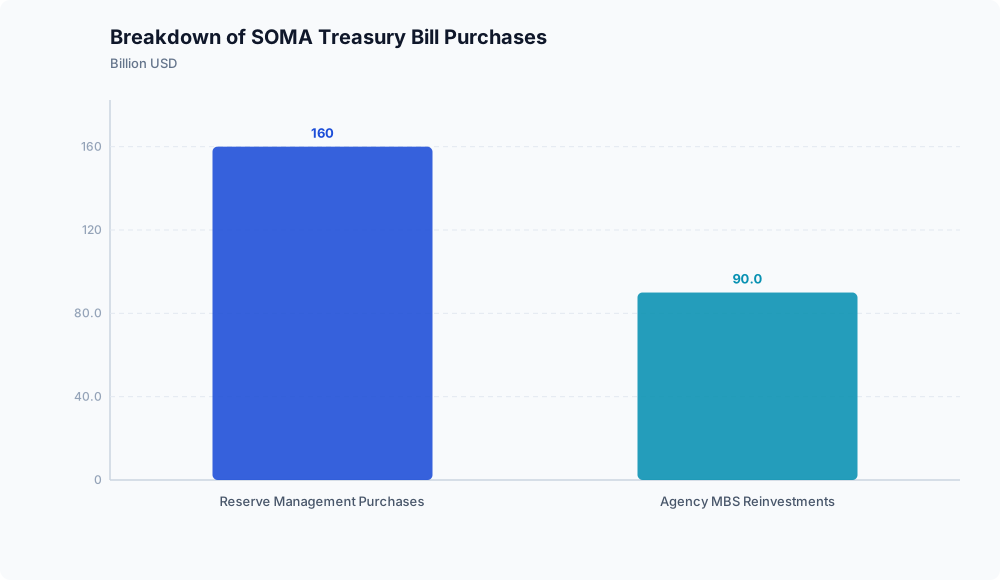
Between early January 2026 and July 2026, the Fed conducted these purchases alongside reinvestments from maturing mortgage debt. As detailed in the July 2026 Monetary Policy Report, the System Open Market Account (SOMA) purchased nearly $250 billion in Treasury bills. This total included roughly $160 billion in dedicated reserve management purchases and $90 billion redirected from principal payments on agency mortgage-backed securities.
These operations increased total Federal Reserve assets by approximately $150 billion to $6.7 trillion, lifting depository institution reserve balances by $54 billion to around $3.1 trillion, per the July 2026 Monetary Policy Report.
This balance-sheet growth occurred alongside an unchanged policy rate. The FOMC held the federal funds target range at 3-1/2 to 3-3/4 percent from the beginning of 2026 through July, as reported in the July 2026 Monetary Policy Report. Expanding short-duration assets to manage settlement plumbing does not ease borrowing conditions across the broader economy while the target policy corridor remains in place.
Transmission across banking and equity markets
The combination of steady interest rates and active reserve management created different effects across market sectors:
1. Commercial banking and credit plumbing
When reserve levels declined enough in late 2025 to elevate SOFR over IORB, financial intermediaries faced higher marginal costs for secured overnight funding. In money markets, elevated funding costs frequently lead institutions to hold precautionary cash, which can compress commercial bank net interest margins and constrain lending capacity.
Through its Treasury bill purchases, the Federal Reserve increased depository institution reserve balances to roughly $3.1 trillion to keep them within the ample range, as noted in the July 2026 Monetary Policy Report. Stabilizing overnight secured borrowing prevents repo disruptions from forcing dealers to deleverage, a process that historically spills over into wider corporate bond spreads and higher credit risk premia.
2. Equity discount rates and valuation multiples
The Fed’s operations insulated money markets from liquidity shocks but provided no direct stimulus to equity multiples. In asset-pricing models, the risk-free rate acts as the baseline for discounting future corporate cash flows. By maintaining the federal funds rate at 3.50% to 3.75%, the FOMC retained a firm hurdle rate, preventing the discount-rate compression that occurs during zero-interest-rate regimes.
Analytical Caveat: The empirical evidence reported in the policy record establishes the size of the Fed’s asset purchases, bank reserve levels, and the benchmark rate range; it does not track equity index levels, price-to-earnings multiples, or realized equity risk premia. Modern valuation theory indicates that maintaining an unyielding 3.50% to 3.75% discount floor mechanistically caps policy-driven multiple expansion, but this remains a conditional deduction based on financial mechanics rather than an observed market return.
Summary

The Federal Reserve’s 2026 balance sheet actions separate liquidity plumbing from macroeconomic easing.
Asset growth of $150 billion directed into Treasury bills buffered bank reserves to about $3.1 trillion, as documented in the July 2026 Monetary Policy Report. Because the policy rate stayed fixed at 3-1/2 to 3-3/4 percent, the cost of capital across the broader economy remained unchanged. Reserve management purchases functioned differently from quantitative easing: while interbank settlement mechanisms were protected, equity valuations continued to depend on corporate earnings and cash flows rather than discount-rate relief.
Disclaimer: This analysis is for informational purposes only and does not constitute investment, financial, real estate, or legal advice. Always consult a licensed financial advisor before making investment decisions.
Frequently asked questions

Why did the Fed buy Treasury bills under reserve management purchases? According to the Brookings Institution, the Fed initiated purchases of Treasury bills to create about $40 billion in additional reserves each month solely to maintain an ample supply of reserves over time and support effective control of the policy rate, keeping operational reserve management separate from monetary policy.
Did the reserve management purchases expand total Fed assets dollar-for-dollar? No. While SOMA purchased nearly $250 billion in Treasury bills between January and July 2026, total Federal Reserve assets increased by about $150 billion to $6.7 trillion, and bank reserves rose by $54 billion to $3.1 trillion, reflecting balance sheet dynamics such as mortgage-backed security runoffs documented in the July 2026 Monetary Policy Report.