Shelter Disinflation and Multifamily NOI Compression
Shelter disinflation and multifamily NOI compression
Why is property net operating income (NOI) compressing even as tenant absorption has rebounded past new construction completions?
While demand has returned, incoming tenants are filling an accumulated backlog of previously delivered units instead of creating tight market conditions. Because renters still have ample options, asking rent growth has stalled near zero. This top-line stagnation prevents gross revenues from keeping pace with ongoing debt service and operational overhead, squeezing property-level margins just as large loan volumes come due for refinancing.
Physical stabilization without pricing power
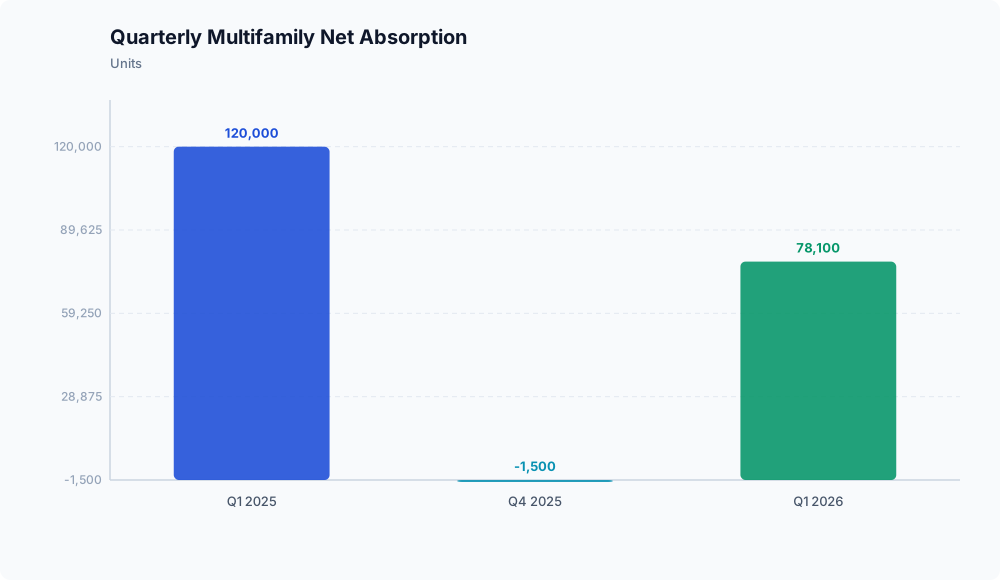
Multifamily supply and demand fundamentals showed a shift in early 2026. Across the United States, net absorption rebounded to 78,100 units in Q1 2026, recovering from negative 1,500 units in Q4 2025, according to Cornovus Capital. Although this remains below the 120,000-unit influx recorded in Q1 2025, net demand once again exceeded quarterly deliveries. Completions fell roughly 30% year-over-year to 58,100 units in Q1 2026 and are projected by market forecasters to drop further as active construction pipelines thin, per Cornovus Capital.
Even with net absorption outpacing new deliveries, the shift has not restored landlord pricing power. The volume of newly absorbed space is clearing an existing physical overhang, leaving market conditions relatively loose.
This dynamic appears even in outperforming regional submarkets. During Q1 2026, the Miami-Fort Lauderdale metropolitan area led all major Southern metros in occupancy and rent growth, according to Cornovus Capital. Yet asking rents in this market grew by just 0.7% year-over-year, alongside a metro vacancy rate of 6.6%, as documented by Cornovus Capital. With the Southeast’s strongest market recording fractional rent growth, broader operating portfolios face flat top-line revenue.
Operating margin squeeze and refinancing shortfalls
With asking rent growth capped below 1%, effective gross income struggles to offset persistent property carrying costs. While specific line-item expense escalations are not quantified in the sector data, muted top-line expansion exposes properties to operational pressures like labor, maintenance, and insurance.
When revenues stagnate, net operating income cannot expand to support higher debt-carrying costs. This creates operational friction for sponsors approaching maturity windows. Approximately $90 billion in multifamily debt is scheduled to mature in 2026, according to Cornovus Capital.
To preserve liquidity, federal regulators have expanded takeout capacity: the Federal Housing Finance Agency increased the 2026 loan purchase caps for Fannie Mae and Freddie Mac to $88 billion each ($176 billion combined), a 20.5% increase over 2025 levels, as reported by Cornovus Capital.
Available agency liquidity does not guarantee an easy exit. Permanent agency takeout loans require properties to meet strict underwritten debt-service coverage ratios (DSCR). When slow top-line growth suppresses underwritten NOI, the maximum debt a property can support shrinks. Borrowers face loan sizing shortfalls that require injecting fresh gap equity to secure refinancing.
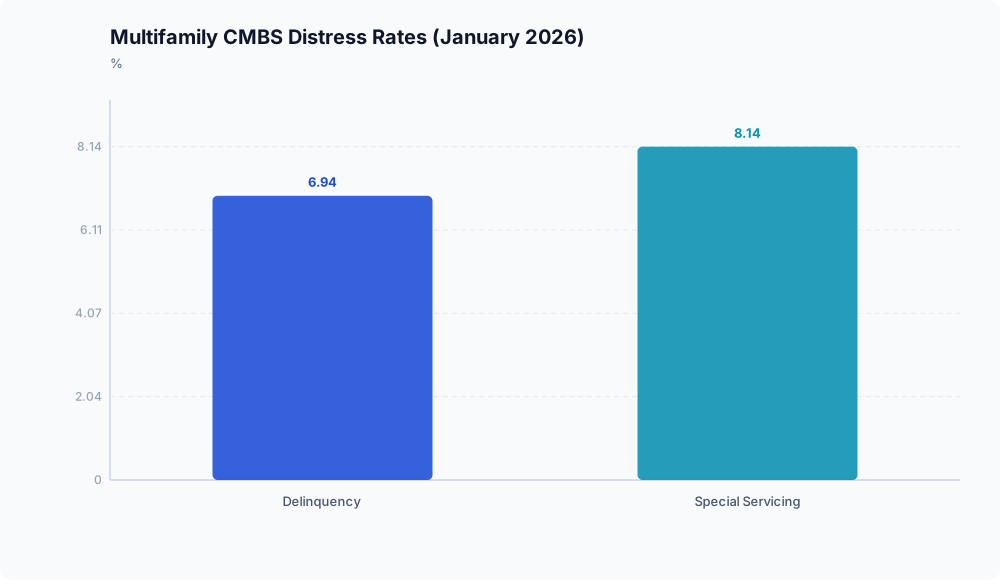
Evidence of this balance sheet strain is surfacing in securitized debt. Multifamily CMBS delinquency climbed 30 basis points in January 2026 to reach 6.94%, while the multifamily CMBS special servicing rate rose to 8.14%, according to Cornovus Capital. While floating-rate bridge loan benchmarks are not tracked directly in this report, the upward trajectory in delinquency and special servicing indicates that flat revenues and debt costs are straining capital stacks.
What the evidence means for operators
The cooling of shelter inflation translates at the asset level into revenue ceilings. Absorption is stabilizing physical occupancy, but it has not shifted pricing leverage back to property owners.
For operators facing 2026 loan maturities, a falling delivery pipeline alone will not provide immediate financial relief. Until lingering supply inventory is absorbed and landlords regain pricing leverage, NOI will remain constrained. Borrowers cannot rely on near-term rent acceleration to bridge refinancing coverage gaps. Managing capital shortfalls will depend primarily on equity reserves or structured debt workouts.
Disclaimer: This analysis is for informational purposes only and does not constitute investment, financial, real estate, or legal advice. Always consult a licensed financial advisor before making investment decisions.
Frequently asked questions

Why are property DSCRs declining if regional absorption is outpacing quarterly completions?
Although Q1 2026 net absorption (78,100 units) exceeded completions (58,100 units), demand is absorbing an accumulated backlog of previously delivered units without creating tenant competition, according to Cornovus Capital. As a result, rent growth remains near zero, leaving NOI insufficient to cover elevated debt carrying costs.
How does 0.7% asking rent growth in the Southeast’s strongest metro affect refinancing valuations?
In Q1 2026, Miami-Fort Lauderdale led major Southern metros with 0.7% year-over-year asking rent growth and a 6.6% vacancy rate, per Cornovus Capital. Constrained top-line growth holds NOI flat, which reduces maximum underwritten loan sizing under strict DSCR requirements and forces sponsors to bring additional gap equity to refinance maturing debt.