
Corporate Capex Rate Cut Repricing Reshapes Equities
Corporate capex and the repricing of Federal Reserve rate cuts
How is surging corporate capital investment reshaping the outlook for Federal Reserve interest rate cuts in 2026?
A sharp rebound in U.S. business investment eliminates the immediate need for Federal Reserve rate cuts by sustaining broad economic growth and keeping inflation pressures elevated. Because corporate demand has accelerated despite prevailing borrowing costs, the traditional justification for easing monetary policy, which is preventing a downturn in private fixed investment, no longer applies. Consequently, discount rates are likely to remain anchored at higher baseline levels, forcing equity markets to rely on earnings growth instead of valuation multiple expansion.
Capital expenditures drive an economic rebound
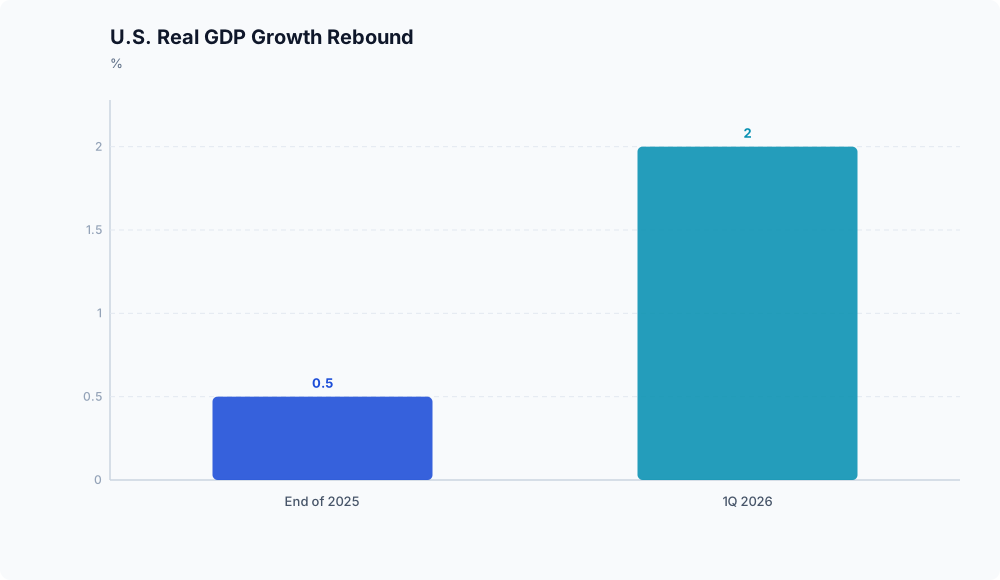
A sharp acceleration in corporate capital spending drove the rebound in U.S. economic activity at the start of 2026. According to the U.S. Department of the Treasury, real GDP grew at an annualized rate of 2.0% in the first quarter of 2026 (1Q26), recovering from the 0.5% pace recorded at the close of 2025. This turnaround showed that domestic demand remained resilient despite late-2025 disruptions, including the drag from a federal government shutdown.
Private capital expenditure drove much of this rebound. Treasury data confirms that business investment expanded by more than 10% in 1Q26, driven by corporate commitments to new equipment and intellectual property products (U.S. Department of the Treasury). This double-digit investment growth indicates that firms actively modernized operational capacity and funded technological infrastructure, offsetting softness elsewhere and reinforcing the productive base of the economy.
Resilient demand delays policy easing
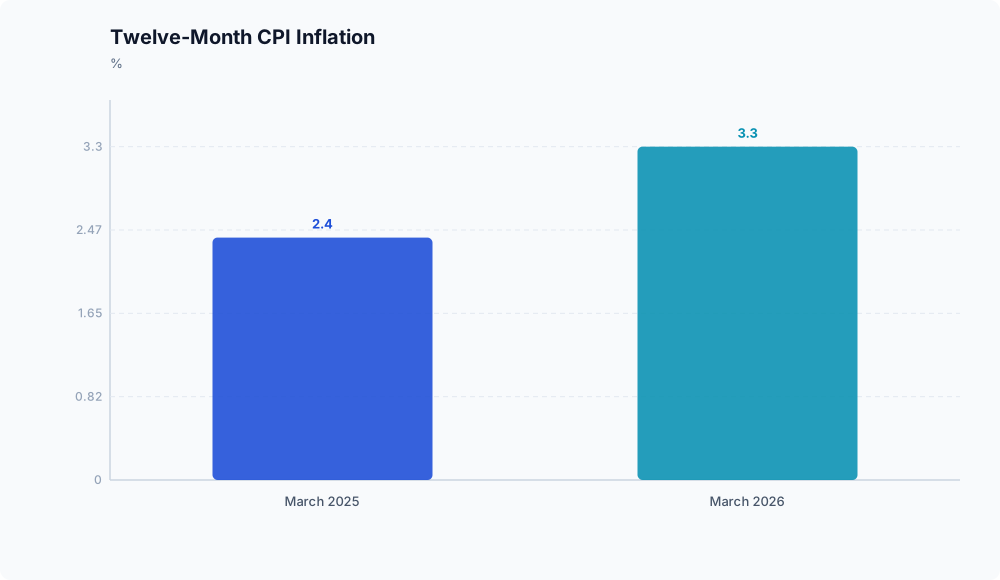
This capital-driven acceleration coincided with renewed headline pricing pressures. Over the twelve months ending in March 2026, headline Consumer Price Index (CPI) inflation rose to 3.3%, climbing from the 2.4% annual pace posted through March 2025, with higher energy costs contributing to the pickup (U.S. Department of the Treasury).
From a monetary policy standpoint, faster economic growth paired with renewed consumer price pressures removes the urgency for near-term Federal Reserve rate reductions. The fact that business investment rose by more than 10% demonstrates that existing borrowing costs have not suppressed enterprise capital allocation (U.S. Department of the Treasury).
While future monetary decisions remain conditional on incoming data prints without formal policy commitments, easing financial conditions into an economy with accelerating headline inflation and high capital expenditures could stoke further price imbalances. This backdrop supports maintaining higher baseline discount rates.
The shift from multiple expansion to earnings delivery
With inflation lingering above long-term targets and discount rates anchored, equity markets face a structural headwind against broad valuation expansion (U.S. Department of the Treasury). As a result, market returns must depend on underlying earnings execution because valuation multiples are not expanding.
Data from FactSet shows that the forward 12-month price-to-earnings (P/E) ratio for the S&P 500 stood at 19.8 as of April 2, 2026, placing market valuations below their 5-year average of 19.9, but above their 10-year average of 18.9. Concurrently, consensus forecasts tracked by FactSet projected a year-over-year S&P 500 earnings growth rate of 13.2% for the first quarter of 2026, raised from an estimate of 12.8% at the end of 2025. Because valuation multiples have stopped expanding beyond intermediate benchmarks, earnings delivery must carry the burden of equity price appreciation.
Strategic capital allocation dictates market leadership
Sustained market leadership now requires a shift toward companies that convert heavy capital commitments into operating margin leverage. When business investment expands at a double-digit rate alongside anchored interest rates, corporate outperformance depends on how efficiently firms generate cash flows from new assets (U.S. Department of the Treasury).
Corporate restructurings and portfolio realignments reflect this focus on operational leverage. For instance, S&P Global detailed forward-looking plans for the anticipated separation of S&P Global Mobility into an independent public company. For investors, market leadership is likely to narrow around firms demonstrating tangible operating efficiency and revenue conversion from their capital outlays, while businesses reliant on speculative multiple re-ratings face elevated downside risks.
Conclusion

The resurgence in U.S. corporate capital expenditures confirms that real economic activity has adapted to current interest rate levels. For investors and policymakers, this dynamic removes the immediate pressure for monetary easing and leaves discount rates elevated. Moving forward, equity appreciation will rely on corporate execution: firms that translate capital outlays into margin-accretive cash flows are positioned to lead, while balance sheets dependent on cheap credit will face pressure under sustained borrowing costs.
Disclaimer: This analysis is for informational purposes only and does not constitute investment, financial, real estate, or legal advice. Always consult a licensed financial advisor before making investment decisions.
Frequently asked questions

How does corporate capital expenditure directly affect the Federal Reserve’s policy timeline? When private business investment expands at a double-digit rate, as seen in the >10% growth recorded in 1Q26 (U.S. Department of the Treasury), it shows that borrowing costs are not choking off productive enterprise investment. Because the real economy continues to expand alongside a rebound in CPI inflation to 3.3%, the central bank faces no pressure to lower policy rates to stimulate economic activity.
Which equity segments face the largest headwind when discount rates remain anchored by business spending? The greatest headwind falls on companies that depend on broad valuation multiple expansion to support share prices. With the S&P 500 forward 12-month P/E ratio constrained at 19.8 (FactSet), firms unable to generate tangible operating margin leverage and direct cash flows from their capital investments face elevated downside risks under anchored discount rates.