
Understanding Treasury Term Premium & Mortgage Spreads
Why Mortgage Rates Can Rise When the Federal Reserve Cuts Rates
Central bank policy cuts do not directly dictate consumer home-financing costs. While the Federal Reserve sets short-term overnight lending rates, 30-year residential mortgages are priced off long-duration benchmarks, chiefly the 10-year U.S. Treasury yield, along with structural intermediation margins and risk premiums. When sovereign debt dynamics, issuance volume, or investor risk requirements push long-term yields and lender spreads upward, consumer mortgage rates climb regardless of monetary policy easing.
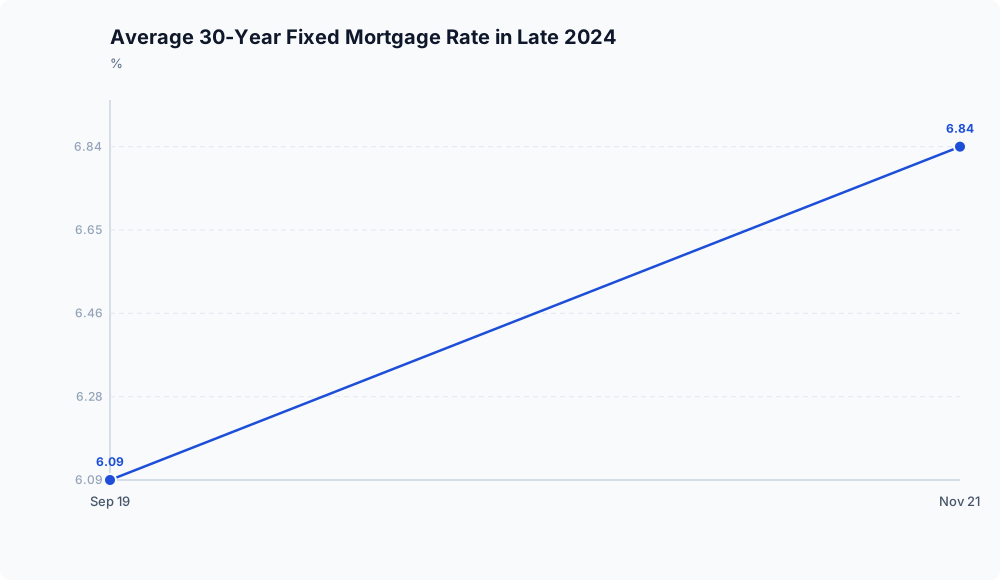
This dynamic appeared in late 2024. Despite the onset of benchmark easing by the Federal Reserve in autumn 2024, residential financing costs separated from monetary adjustments. According to Fannie Mae, the average rate on a 30-year fixed mortgage in the United States rose from 6.09 percent on September 19 to as high as 6.84 percent on November 21.
Transmission mechanism: Treasuries over policy targets
Long-duration benchmarks, rather than overnight central bank policy rates, transmit sovereign debt dynamics to consumer borrowing costs. Because residential mortgages carry long effective durations, retail borrowing costs reflect yields on benchmark debt instruments, particularly the 10-year Treasury note, plus an added risk premium.
When sovereign debt issuance pressures or shifting investor expectations elevate yields on benchmark bonds, retail credit costs adjust upward. As a result, short-term rate reductions by the central bank can coincide with higher retail borrowing expenses whenever the broader bond market demands higher yields to hold long-term government debt.
Structural spreads and intermediation costs
Beyond baseline Treasury yields, the total cost paid by the borrower depends on two distinct layers of spreads: the bond-to-mortgage risk spread and the primary-secondary origination spread.
1. The Treasury-to-mortgage spread
Historical data from First American indicates that the 30-year fixed mortgage rate has remained an average of 1.7 percentage points (170 basis points) higher than the 10-year Treasury bond yield since the end of the Great Recession.
While this 170-basis-point margin is a long-run baseline, the spread exhibits significant cyclical volatility. Between 2000 and 2023, the monthly average spread reached or exceeded 200 basis points across 59 months, representing approximately 21 percent of the recorded period, as tracked by First American Financial Corporation.
2. The primary-secondary intermediation spread
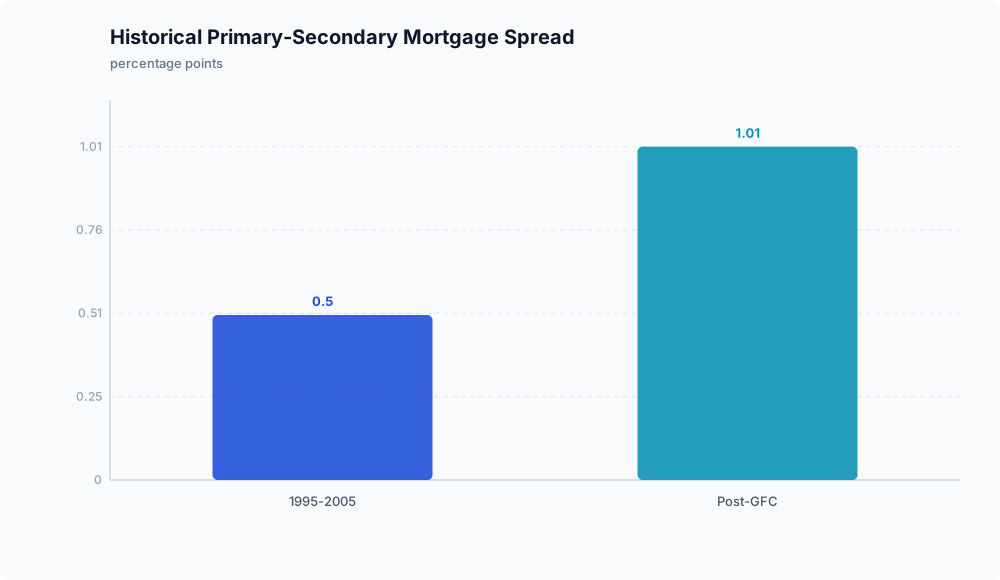
Compounding this baseline yield gap are structural shifts within the mortgage origination pipeline. According to baseline data from Fannie Mae, the primary-secondary mortgage spread, the gap between interest rates offered to retail borrowers and the yields on mortgage-backed securities, averaged 0.5 percentage points from 1995 to 2005. Following the Great Financial Crisis, this intermediation margin widened to an average of 1.01 percentage points, driven by permanently higher origination costs and increased guaranty fees.
Housing market impacts: the rate lock-in effect
When benchmark yields remain sustained and intermediation spreads stay elevated, retail mortgage rates remain well above the ultra-low financing levels secured by households during previous market cycles.
This environment reinforces residential “rate lock-in.” Existing homeowners with legacy mortgages have a strong financial disincentive to sell their properties, as listing a home often requires exchanging low-cost debt for market-rate financing. In turn, prolonged spread elevation restricts the flow of existing homes onto the secondary market, keeping transaction volumes depressed and residential inventory constrained.
Regarding commercial real estate, higher baseline yields across the duration curve generally raise debt-service hurdles for maturing commercial loans. However, the validated record does not provide specific data regarding commercial debt cliffs, origination cohorts, or lender distress. The immediate scope and consequences for commercial refinancing therefore remain undetermined.
Market mechanics and rate cuts

The divergence between mortgage rates and Federal Reserve rate cuts reflects how consumer borrowing conditions depend on structural bond-market mechanics rather than headline monetary policy. Because primary intermediation costs have doubled relative to pre-2008 norms, any upward movement in long-term sovereign yields flows directly through an expanded spread environment. For borrowers and market participants, Federal Reserve easing alone will not reliably restore affordable mortgage financing unless long-term Treasury yields decline and mortgage risk spreads compress back toward historical baselines.
Disclaimer: This analysis is for informational purposes only and does not constitute investment, financial, real estate, or legal advice. Always consult a licensed financial advisor before making investment decisions.
Frequently asked questions

Why do 30-year mortgage rates track the 10-year Treasury yield instead of the Federal Reserve’s federal funds rate? Mortgages carry long effective durations, typically prepaid or refinanced over a horizon that closely mirrors the 10-year Treasury note. In contrast, the federal funds rate is an overnight lending rate set by the central bank. Retail mortgage pricing therefore reflects long-term sovereign bond yields and investor risk premiums rather than day-to-day central bank targets.
What is the historical average spread between the 10-year Treasury and the 30-year fixed mortgage? Since the end of the Great Recession, the 30-year fixed mortgage rate has averaged approximately 1.7 percentage points (170 basis points) above the 10-year Treasury yield, according to First American. However, this margin is volatile: between 2000 and 2023, the spread reached or exceeded 200 basis points across roughly 21 percent of the recorded months.