
Treasury Bear-Steepening & Equity Multiple Compression Explained
Treasury Yields and Equity Multiple Compression Explained
When surging long-term interest rates spark questions about Treasury bear-steepening and equity multiple compression, the direct pressure on stocks originates from rising benchmark borrowing costs. While market commentary often associates sharp surges in long rates with curve steepening, reported market data focuses specifically on the benchmark 10-year Treasury yield rather than short-term interest rates or yield curve spreads.
When the 10-year U.S. Treasury yield climbs to match the forward earnings yield of the S&P 500, the traditional valuation cushion for equities narrows, setting a higher hurdle rate for risk assets and leaving equity returns dependent on corporate earnings growth.
The rise in real rates
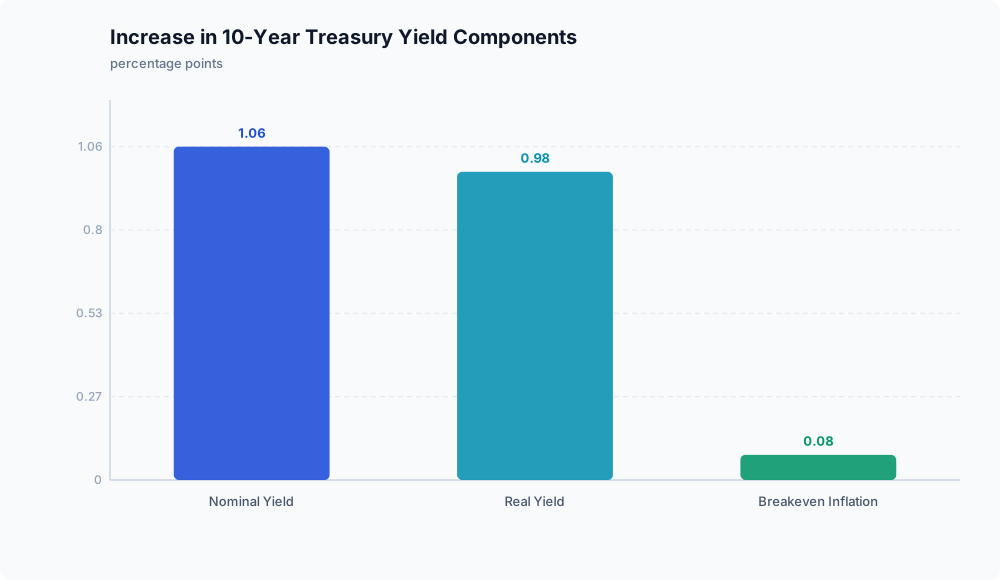
Between December 31, 2025, and October 9, 2026, the nominal 10-year U.S. Treasury yield increased by 1.06 percentage points (106 basis points), climbing from 4.18% to 5.24%, as reported by Infrastructure Capital.
A breakdown of the benchmark yield shows that the increase came almost entirely from higher real borrowing costs rather than rising inflation expectations:
- 10-year real yield: rose 0.98 percentage points, climbing from 1.93% to 2.91% Infrastructure Capital.
- 10-year breakeven inflation rate: rose 0.08 percentage points, shifting from 2.25% to 2.33% Infrastructure Capital.
Higher real yields accounted for approximately 92% of the increase in nominal yields Infrastructure Capital. Long-term inflation expectations remained anchored near 2.33% Infrastructure Capital. A real-rate-driven increase raises the inflation-adjusted cost of capital across the economy and increases the discount rate applied to future cash flows without delivering the revenue boost that unexpected inflation can provide.
Yield parity removes the headline equity spread
The rise in risk-free rates directly affects equity valuations. According to FactSet’s October 9, 2026 Earnings Insight cited by Infrastructure Capital, the S&P 500 traded at a forward 12-month price-to-earnings (P/E) ratio of 19.1. That multiple translates to an inverse forward earnings yield of approximately 5.24% Infrastructure Capital.
On October 8, 2026, the 10-year Treasury yielded 5.22% (comprising a 2.87% real yield and a 2.35% breakeven inflation rate) before reaching 5.24% on October 9, 2026 Infrastructure Capital. Comparing the earnings yield directly against the 10-year Treasury rate reflects the framework of the Fed Model pro.stockalarm.io, while longer historical series track equity risk spreads against the 10-year Treasury back to 1871 eco3min.fr. When both metrics align near 5.24%, the headline spread between expected earnings and risk-free government yields effectively falls to zero.
However, an earnings yield is built from analyst forecasts rather than guaranteed payments Infrastructure Capital. Broader risk compensation for equities is captured by model-based measures: at the start of October 2026, valuation analysis by Aswath Damodaran reported an expected equity return of 8.99% and an implied equity risk premium (ERP) of 3.70% over a 10-year Treasury rate of 5.29% (or 3.92% over a dollar risk-free rate of 5.07%) Infrastructure Capital. That premium dipped below 4% for the first time that year after September’s jump in Treasury rates Infrastructure Capital.
Pressure on valuations and long-duration equities
Rising benchmark rates mechanically drive equity multiple compression. As detailed by pro.stockalarm.io, the required equity return equals the risk-free rate plus the equity risk premium. Because a stock’s justified price is the present value of future cash flows discounted at that required return, a higher risk-free benchmark mechanically reduces justified valuation multiples for the same stream of earnings pro.stockalarm.io.
With real yields reaching 2.91% Infrastructure Capital, discount rates rise across all asset classes. This dynamic exerts the greatest pressure on long-duration equities—speculative growth companies whose valuations rely heavily on cash flows projected far into the future, making them the most sensitive to higher discount rates pro.stockalarm.io.
Dependence on corporate earnings growth

When valuation multiples face headwinds from Treasury yields at 5.24% Infrastructure Capital, equities cannot rely on P/E expansion to generate capital gains. Instead, sustaining index levels requires companies to deliver on demanding earnings projections.
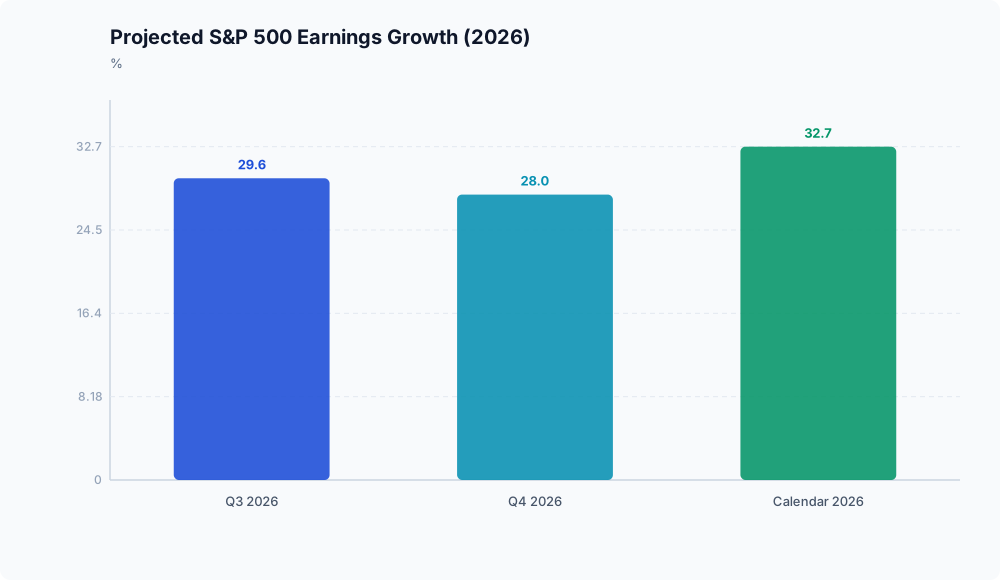
According to FactSet consensus estimates cited by Infrastructure Capital, analysts projected strong S&P 500 earnings growth throughout 2026:
- Q3 2026: 29.6% Infrastructure Capital
- Q4 2026: 28.0% Infrastructure Capital
- Full-Year 2026: 32.7% Infrastructure Capital
A Treasury yield represents a contractually fixed return Infrastructure Capital, pro.stockalarm.io. In contrast, forward earnings yields depend on execution. Furthermore, in the twelve months leading into 2026, S&P 500 companies returned only 63% of their earnings to shareholders through dividends and buybacks—a low not seen since 2004 Infrastructure Capital. If corporate earnings fail to meet consensus growth targets near 30%, the realized earnings yield falls, elevating the risk of further multiple contraction to realign with risk-free yields.
Implications for equities

The convergence of the 10-year Treasury yield at 5.24% with the S&P 500 forward earnings yield of 5.24% establishes a demanding backdrop for equities Infrastructure Capital. With 10-year real rates at 2.91% Infrastructure Capital, capital costs remain elevated.
When the implied equity risk premium narrows to 3.70% Infrastructure Capital, the valuation buffer for adverse surprises thins pro.stockalarm.io. In this environment, equity performance depends fundamentally on earnings delivery rather than multiple expansion.
Disclaimer: This analysis is for informational purposes only and does not constitute investment, financial, real estate, or legal advice. Always consult a licensed financial advisor before making investment decisions.