
Commercial Real Estate Lending Standards: 2026 Outlook
Navigating the CRE refinancing wall under stricter lending criteria
How do prevailing commercial real estate lending standards affect borrowers facing the 2025-2029 debt maturity wave?
Conservative underwriting hurdles, chiefly elevated debt yield requirements, stricter debt service coverage floors, and compressed loan-to-value (LTV) limits, create a structural refinancing shortfall. Even when properties generate stable net operating income, senior takeout loans sized under modern parameters often fail to cover the principal of expiring legacy debt. Consequently, borrowers must supply fresh equity, accept costlier junior capital, or surrender assets, despite remaining current on their loan obligations.
The $4 trillion refinancing wave
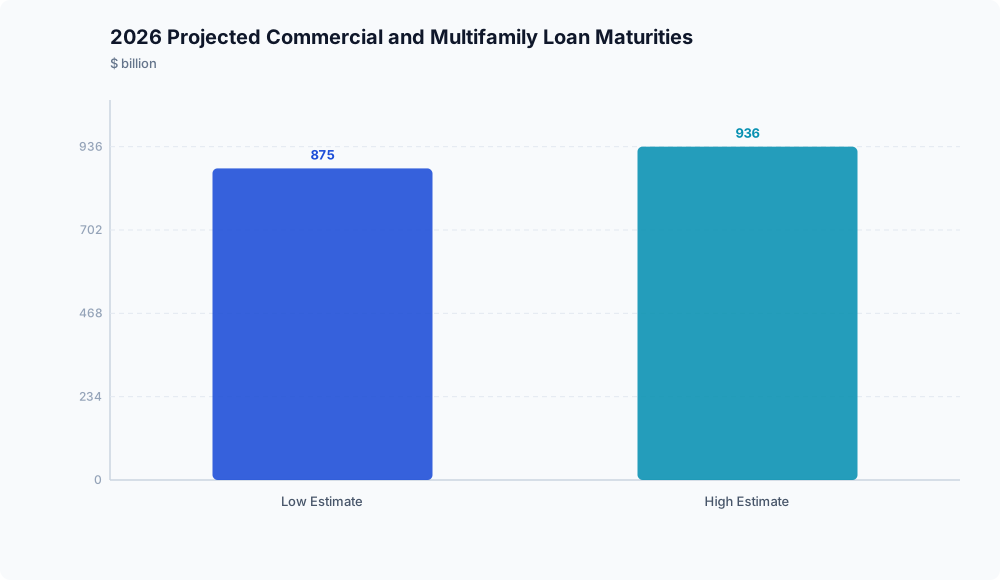
The timeline for resolving commercial real estate balance sheets is constrained by the volume of upcoming loan expirations. According to forecasts reported by investingincre.com, more than $4 trillion in U.S. commercial real estate debt is projected to mature between 2025 and 2029. A significant concentration of this debt arrives near term, with between $875 billion and $936 billion in commercial and multifamily loans scheduled to reach maturity in 2026 alone (investingincre.com).
This volume establishes a calendar deadline: property owners cannot defer balance-sheet resolutions indefinitely. While commercial debt is divided among regional banks, money-center institutions, and securitized vehicles, aggregate totals detailing the precise distribution of regional bank expiries relative to securitized debt remain unspecified in available data.
Furthermore, while property owners must negotiate with lenders under modern underwriting standards, exact statistical contributions of Federal Reserve Senior Loan Officer Opinion Survey (SLOOS) posture shifts, formal spread markups, and explicit debt-yield baselines remain unquantified in the available data series. Nonetheless, the fixed maturity schedule requires properties to clear current origination hurdles or seek restructuring.
Latent friction: performing loans with inadequate debt yields
Securitized vehicles provide clear empirical evidence of how underwriting hurdles affect upcoming expiries. According to research from Trepp, the October 2026 private-label commercial mortgage-backed securities (CMBS) hard maturity cohort totals $4.70 billion across 144 loan pieces comprising 118 whole loans.
Underlying credit metrics reveal latent refinancing friction. Of the October 2026 cohort, $1.30 billion carries a debt yield below 6.0% (Trepp). Within this $1.30 billion sub-6.0% group, 97.00% of the loan balances were actively performing at the time of reporting (Trepp).
This dynamic demonstrates that routine debt service compliance can mask structural takeout shortfalls. An asset capitalized under more accommodating legacy terms may cover its ongoing monthly obligations, yet still fail to generate the net operating income necessary to satisfy modern debt yield hurdles upon maturity.
The capital stack squeeze and liquidity disparities
When senior takeout proceeds fall short of retiring balances, property sponsors face three paths:
- Issue capital calls to limited partners or deploy reserves to pay down principal;
- Secure higher-cost mezzanine financing or preferred equity to bridge the capital stack shortfall; or
- Execute a deed-in-lieu of foreclosure if projected property cash flows cannot justify new capital or service expensive junior financing.
Liquidity distribution within commercial real estate lending standards further complicates these paths. Institutional capital has become highly selective, favoring trophy assets over generic properties. For example, TreppTalk documented that New York single-asset, single-borrower (SASB) loans accounted for 60% of all private-label office CMBS origination volume through August 4, 2026. This geographic and structural concentration shows that senior lending liquidity in challenged asset classes has leaned heavily toward signature assets in major gateway hubs, leaving multi-borrower conduit pools and commodity assets with narrower refinancing avenues.
Analytical synthesis: operational health versus balance sheet solvency
The upcoming maturity window marks a clear divide between operational property performance and capital structure solvency. While headline defaults often stem from tenant loss or severe occupancy declines, the current environment generates structural balance sheet distress purely through underwriting shifts.
Because senior lenders size takeout loans based on stricter debt yield and debt service thresholds, stable operating assets are encountering substantial equity gaps. The broader market impact will ultimately depend on whether sponsors possess the capital reserves and risk appetite to subsidize these assets. While complete loan-level data detailing how many sponsors execute mezzanine rescues versus choosing asset forfeiture is not yet available, the scheduled maturities through 2029 ensure that transaction clearing prices and capital stack structures will continue to adjust to today’s senior lending constraints.
Disclaimer: This analysis is for informational purposes only and does not constitute investment, financial, real estate, or legal advice. Always consult a licensed financial advisor before making investment decisions.
Frequently asked questions

What happens when a private-label CMBS loan reaches a hard maturity date without takeout financing?

When a loan reaches its hard maturity date without refinancing proceeds or full payoff, the borrower defaults on principal repayment. Because CMBS loans are non-recourse, the special servicer evaluates options based on recovery value. Sponsors must negotiate an extension, inject capital to execute a restructuring, or surrender the property via foreclosure or a deed-in-lieu of foreclosure.
How does an increase in a lender’s required debt yield create a cash-in refinancing requirement for borrowers?
A debt yield measures a property’s net operating income (NOI) as a percentage of the total loan amount ($ ext{Debt Yield} = \frac{\text{NOI}}{\text{Loan Amount}}$). If an incoming lender increases the minimum debt yield hurdle while property NOI remains flat, the maximum allowable senior loan balance decreases. To refinance and retire the existing debt balance, the borrower must fund the resulting shortfall with cash equity.