
Agency MBS Stress Test Calibrations and Bank Demand
Can adjustments to Federal Reserve stress testing calibrations revive bank demand for Agency mortgage-backed securities (MBS) and lower mortgage rates?
In theory, adjustments to Federal Reserve stress tests could revive bank demand for Agency mortgage-backed securities (MBS) and help lower mortgage rates, but supervisory records do not confirm that any such changes are taking place. Lower modeled loss severities under supervisory stress tests would reduce the capital drag on bank balance sheets, freeing up capacity to absorb Agency MBS. Even so, supervisory records do not disclose any explicit recalibration of these loss parameters. Whether stress test dynamics will translate into sustained institutional buying or lower consumer borrowing costs remains an open question.
The baseline: A wider roster with a thinner cushion
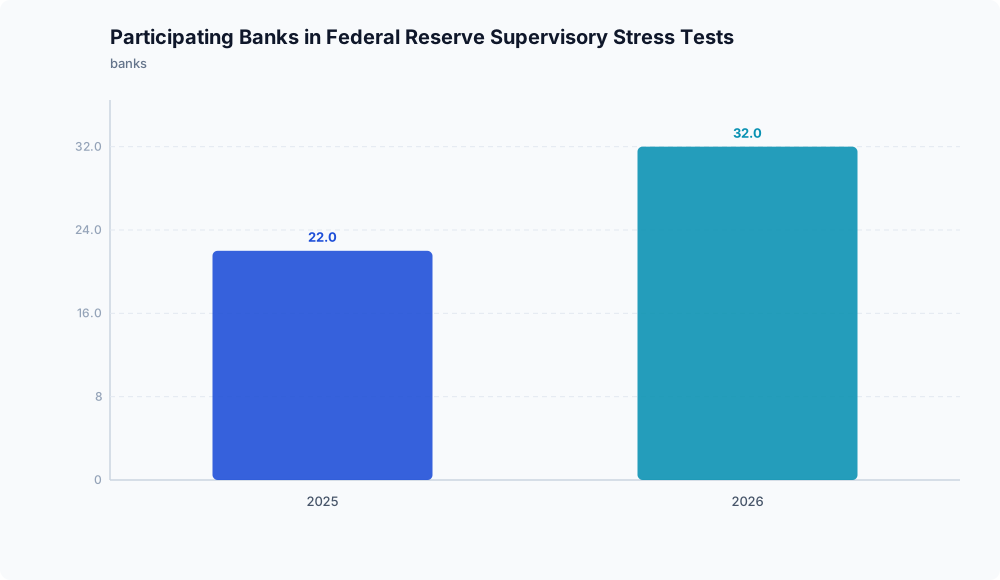
The supervisory backdrop for 2026 reflects an expanded institutional scope navigating a tighter capital starting point. According to the Federal Reserve Board, 32 banking organizations are participating in the 2026 supervisory stress test, up from 22 in 2025. This increase occurs because Category IV institutions generally participate on an alternate-year cycle, meaning they rotated back into the testing group after sitting out in 2025. Because of this rotation, aggregate year-over-year figures do not reflect an identical institutional sample.
At the same time, the baseline capital cushion for these lenders has declined slightly. The aggregate common equity tier 1 (CET1) capital ratio across participating institutions dropped from 13.2% to 12.8% in 2025, as reported by the Federal Reserve Board. Although the Fed noted that 12.8% remains consistent with ranges seen over the prior decade, this 40-basis-point decline means the sector enters the 2026 hypothetical stress scenarios with less upfront loss-absorbing equity.
Stress test mechanics and the Global Market Shock
A bank’s capacity to hold risk-bearing assets depends on its regulatory capital hurdles, particularly its resulting Stress Capital Buffer (SCB). In stress testing mechanics, the Global Market Shock (GMS) imposes instantaneous mark-to-market losses on trading and available-for-sale portfolios. These paper losses deplete CET1 capital, directly driving peak-to-trough drawdowns that determine the bank’s SCB requirement.
If the Fed were to soften modeled loss severities for agency pass-through MBS, mark-to-market trading losses would decrease, muting the CET1 capital draw and easing upward pressure on the SCB. However, direct evidentiary disclosures detailing specific adjustments to agency MBS loss severities or quantitative revisions to GMS parameters are absent from the supervisory record. Without confirmed data, the precise empirical effect of any hypothetical MBS recalibration on capital requirements remains analytically unverified.
The lingering supply-demand imbalance
The secondary market for Agency MBS is still dealing with dislocations that emerged during the 2022-2023 rate-hiking cycle. The Federal Reserve began raising rates on March 16, 2022, lifting the federal funds rate target to 0.25% to 0.50% at a time when two-year and 10-year Treasury yields sat at 1.9% and 2.2%, respectively, according to DoubleLine.
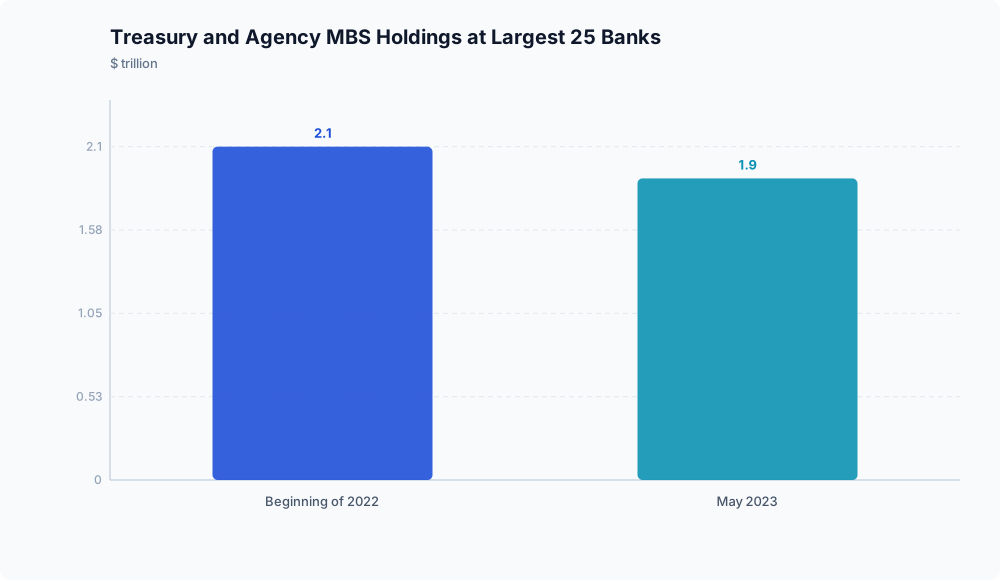
As interest rates spiked, major depositories retreated. The largest 25 commercial banks trimmed their collective holdings of Treasuries and Agency MBS from roughly $2.1 trillion in early 2022 to $1.9 trillion by May 2023, as documented by DoubleLine. This pullback collided with an influx of secondary supply:
- The Federal Reserve ended quantitative easing in March 2022, introducing roughly $15 billion to $20 billion per month in market supply via reinvestment runoff caps (DoubleLine).
- Regional bank receiverships released approximately $103 billion in total agency holdings to be liquidated, including $65 billion in agency pass-throughs, $24 billion in collateralized mortgage obligations, and $14 billion in commercial MBS as of the fourth quarter of 2022 (DoubleLine).
This mismatch widened current coupon Agency MBS spreads by roughly 75 basis points across 2022, ending the year at 143 basis points, according to DoubleLine. In a market where annual gross issuance averaged $1.5 trillion between 2011 and 2020 (peaking in 2020 amid historic refinancing activity, according to Western Asset), the absence of bank balance sheet sponsorship created severe spread cheapening relative to sovereign debt.
Secondary relief versus retail mortgage transmission
Theoretically, wider spreads increase nominal yields, allowing Agency MBS to provide attractive risk-adjusted returns on equity compared to cash or Treasuries. Furthermore, if supervisory capital treatments soften, renewed bank demand could absorb secondary supply, bid up pass-through valuations, and compress secondary yields.
Yet connecting secondary spread compression to lower consumer borrowing rates involves practical friction:
- Current supervisory records document baseline aggregate capital ratios rather than explicit statutory relief for MBS risk weights, leaving depositories constrained by broad capital preservation and interest rate risk limits.
- While tighter secondary MBS spreads lower the cost of securitizing loans in to-be-announced (TBA) forward contracts, primary mortgage rates will fall only if originators face enough competitive pressure and operational capacity to pass those savings along to retail borrowers, instead of absorbing the spread to rebuild origination margins.
Balance sheet constraints and transmission outlook

The structural mechanism is clear: bank balance sheets absorb a major share of Agency MBS issuance, and supervisory stress test charges influence that capacity. Without documented supervisory changes to Global Market Shock parameters or statutory capital weights, however, bank demand remains tied to baseline capital constraints. Even if regulatory relief materializes and compresses secondary yields, retail mortgage borrowers will benefit only if competitive conditions compel originators to pass through those savings.
Disclaimer: This analysis is for informational purposes only and does not constitute investment, financial, real estate, or legal advice. Always consult a licensed financial advisor before making investment decisions.
Frequently asked questions

Why are 32 institutions participating in the 2026 stress test compared to 22 in 2025? The increase reflects the supervisory calendar rather than a change in bank size. Under Federal Reserve rules, banking organizations subject to Category IV standards generally participate in supervisory stress tests every other year. Category IV firms were largely exempt in 2025 and rotated back onto the testing roster for the 2026 cycle, according to the Federal Reserve Board.
How does a reduction in Global Market Shock severity directly alter a bank’s Stress Capital Buffer? The Global Market Shock imposes instantaneous mark-to-market losses on trading and available-for-sale portfolios, which reduces CET1 capital during hypothetical projections. Because a bank’s Stress Capital Buffer (SCB) is determined by its peak-to-trough capital depletion under stress, a lower modeled loss severity diminishes mark-to-market trading deductions, preserves starting CET1 equity, and curbs the upward capital charge applied to the institution’s SCB.