
Fed Stress Capital Buffer Agency MBS Shock Relief Explained
How the Fed’s recalibrated market shock impacts bank capital buffers
By dampening the hypothetical severity applied to agency pass-through debt and select commodities, the Federal Reserve directly curbs hypothetical trading markdowns large institutions evaluate during supervisory stress testing, as detailed in the Federal Reserve 2026 Stress Test Scenarios. Because supervisory stress test results are used in part to establish capital requirements, mitigating these simulated shocks lessens upward pressure on mandatory capital cushions.
Recalibrating the 2026 stress test parameters
In finalizing the supervisory parameters for the 2026 stress testing cycle, the Federal Reserve set December 31, 2025, as the effective cut-off date for participating institutions’ balance sheet and income statement data, according to the Federal Reserve 2026 Stress Test Scenarios.
Following a public comment period, the central bank revised its global market shock component by reducing severity from initially proposed levels. The Board moderated the shock magnitudes applied to agency pass-through securities and certain commodities, as documented in the Federal Reserve scenario release.
The 2025 market baseline
This supervisory adjustment followed changes in monetary policy and mortgage market dynamics over the course of 2025. Market analysis from Ginnie Mae shows that the Federal Reserve held a neutral stance through the first half of 2025 before loosening policy as labor market conditions softened. The central bank implemented three interest rate cuts totaling 75 basis points in the second half of the year and concluded its balance sheet runoff (quantitative tightening) in December 2025, according to Ginnie Mae.
Secondary market conditions reflected this shifting environment alongside substantial non-central bank absorption of mortgage paper:
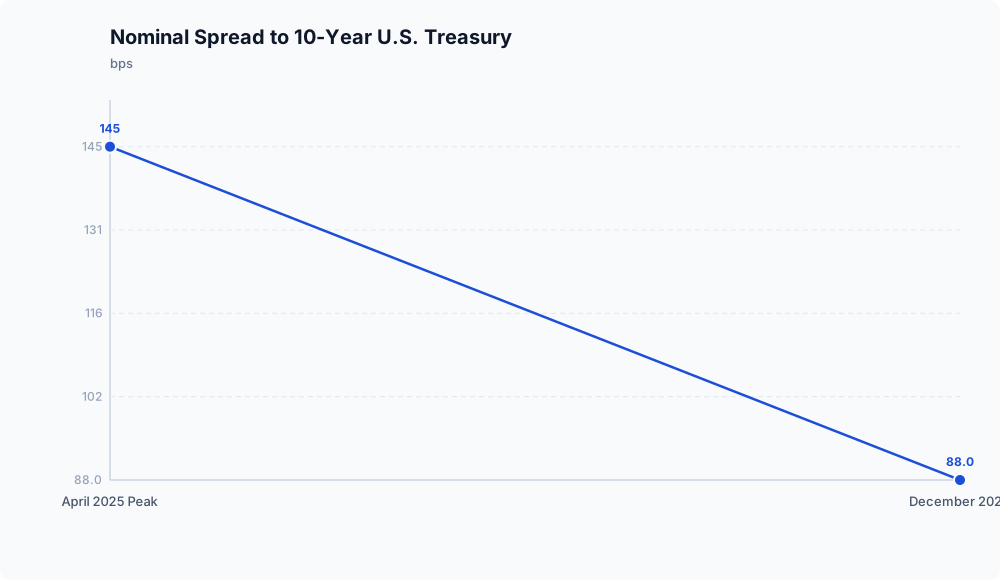
- Nominal spreads to the 10-year U.S. Treasury narrowed by approximately 57 basis points, falling from an April 2025 peak of 145 basis points to 88 basis points by the end of December 2025, according to Ginnie Mae.
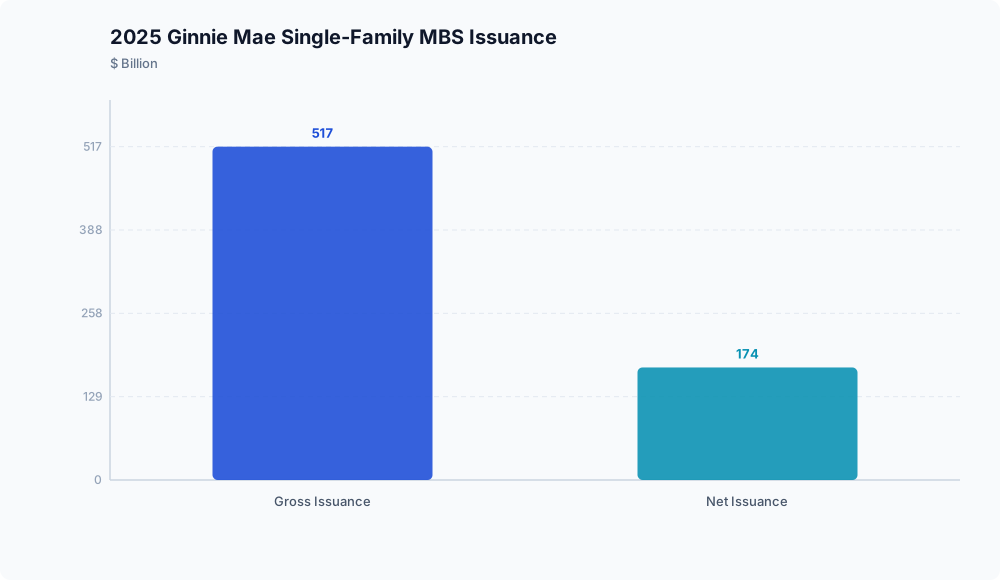
- Ginnie Mae led the agency mortgage-backed securities (MBS) sector in calendar year 2025, logging single-family gross issuance of roughly $516.9 billion and net issuance of $174.5 billion, per Ginnie Mae.
- Private and non-central bank balance sheets absorbed substantial supply in 2025: broker-dealer holdings rose by 247.9% Ginnie Mae, while allocations across money market funds, pension funds, and real estate investment trusts (REITs) each rose by 22.6%, as reported by Ginnie Mae.
Balance sheet mechanics: from markdowns to capital requirements
The Federal Reserve’s adjustments align the supervisory stress framework with the tighter spreads and baseline conditions present at year-end 2025.
Supervisory stress tests evaluate the financial resilience of large banking institutions by estimating hypothetical losses, revenues, expenses, and post-stress capital levels under adverse scenarios, as noted in the Federal Reserve 2026 Stress Test Scenarios. Moderating the hypothetical shock sizes on agency pass-through securities curtails modeled balance sheet declines in these holdings.
Because the Federal Reserve uses stress test projections in part to set capital requirements for large banks, smaller modeled losses avoid unnecessary escalation in required capital levels, preserving capital cushions intended to absorb losses during economic downturns Federal Reserve 2026 Stress Test Scenarios.
Limits of the disclosed data
While lower shock sizes reduce modeled loss projections, the precise dollar relief across individual balance sheets remains unquantified.
The Federal Reserve 2026 Stress Test Scenarios confirms the downward adjustments in shock sizes for agency pass-through debt and commodities, but the scenario documentation does not publish asset-by-asset haircut deltas, specific basis-point calibrations, or projected trading losses by institution.
The exact regulatory capital impact for any individual bank cannot be determined from scenario releases alone. Each institution’s performance depends on its specific portfolio inventory of agency pass-through securities and commodity exposures as of December 31, 2025, alongside internal capital planning.
Disclaimer: This analysis is for informational purposes only and does not constitute investment, financial, real estate, or legal advice. Always consult a licensed financial advisor before making investment decisions.
Frequently asked questions

Which banking organizations are subject to the Federal Reserve’s Global Market Shock component?
The Federal Reserve conducts stress tests to assess how large banks perform under hypothetical economic conditions, applying the supervisory scenario components to evaluate whether institutions remain capitalized to support lending during a severe recession, per the Federal Reserve 2026 Stress Test Scenarios.

How are the 2026 stress test results used by bank regulators?
The Federal Reserve uses the results of the annual stress tests, in part, to set large bank capital requirements, evaluating institutional resilience through estimated losses, revenues, expenses, and capital cushions under simulated recession environments, according to the Federal Reserve 2026 Stress Test Scenarios.